
You can grind coffee beans without a grinder at home using common kitchen tools. The result may not be as consistent as a proper grinder, but it can be good enough to rescue your morning and still deliver a fresh cup.
Think of this as a quick fix rather than a replacement for a proper grinder, giving you a practical way to make fresh coffee when you're in a pinch.
What to Know Before Grinding Coffee Beans
Coffee grind size matters because it controls how fast water pulls flavor from the whole bean coffee. Too coarse, and the cup tastes thin and flat. Too fine and it turns bitter from over-extraction.
Most kitchen tools produce a coffee grind size that lands somewhere in the coarse to medium range, which works best for brewing methods that are more forgiving of uneven particles.
"Close enough" beats nothing, and millions of people have brewed a cup of coffee without a coffee grinder in sight. A batch of unevenly broken coffee particles can still make a decent drink.
Pro Tip: If you aimed for medium but landed coarse, don't force it through a drip filter. Switch to French press or cold brew and always grind just before you brew for maximum freshness. |
Match the Coffee Grind Size to Your Brewing Method
Before grabbing any equipment to process beans without a grinder, know your ideal target texture. Here is a quick reference guide:
Grind Size | Texture Comparison | Best For |
|---|---|---|
Coarse | Chunky sea salt | French press, cold brew |
Medium | Regular sand | Drip coffee maker, pour-over |
Fine | Table salt | Avoid using improvised tools |
If you aim for a coarse texture and land on medium-coarse, you are doing great. The only failure is pulverizing everything into powder; that is where bitterness takes over.
To learn the method using a standard coffee grinder, read our guide on how to grind coffee beans the right way.
Aim for an Even Consistency
Uneven coffee grounds are the enemy of a clean cup. When particles vary in size, fine pieces over-extract while larger chunks under-extract, all in the same brew.
The beverage tastes like it cannot make up its mind. A few easy habits keep things on track:
- Work in small batches; never overload the tool
- Use short pulses instead of running the blender blade without stopping for an extended time, which builds heat and strips flavor
- Shake or stir between rounds to redistribute the whole coffee beans
- Sift out larger particles before brewing if needed
Pick whatever tool is within arm's reach, and let's get to work. Breaking whole beans into smaller pieces creates more surface area, allowing water to extract flavor more effectively.
What are the Ways to Grind Coffee Beans Without a Grinder?
There are six simple options if you need to know how to grind coffee beans without a grinder: using a blender, food processor, mortar and pestle, rolling pin, hammer or meat tenderizer, or even a knife or heavy pan.
Each one gets you a fresh cup of coffee with no extra appliance required.
Use a Blender
Best For: Medium to coarse grind, speed, and larger batch sizes.
What You Need: Standard blender, measuring scoop.
How To Do It:
- Add a small amount of whole beans; never fill the jar more than halfway
- Run short blender pulses of 1 to 2 seconds each
- Shake the jar between pulses to redistribute the beans
- Check the particle size and stop before the heat builds up
Grind Result: Medium to medium-coarse, workable for immersion pots and drip coffee. Watch-Outs: Do not run the blender without stopping; heat dulls the flavor.
Do not overload the jar or the beans; just bounce around without breaking down. When time is short, this is a way to quickly finish the job.
For a deeper dive into this approach, explore our guide on how to grind coffee beans in a blender.
Use a Food Processor
Best For: Medium grind size for drip coffee or cold brew; the wider bowl distributes beans better than a blender jar.
What You Need: Food processor with a standard blade.
How To Do It:
- Add beans in a single layer across the bowl
- Pulse in short bursts
- Pause and shake the bowl to redistribute the whole bean coffee
- Repeat until the texture reaches your ideal target
Grind Result: Medium consistency with some uneven particles, but workable. Watch-Outs: Not the right call for precision brewing like pour-over.
It is best suited for forgiving brew styles where minor variation does not tank the final cup. A food processor is a great option for an everyday cup of coffee.
Use a Mortar and Pestle
Best For: Controlled coarse-to-medium grind with no electricity required.
What You Need: Mortar and pestle, ceramic or stone preferred.
How To Do It:
- Add a small handful of beans
- Press down hard to crack them open first
- Switch to a grinding circular motion
- Work in sections rather than all at once
- Check the texture often and stop when it looks right
Grind Result: Coarse grind to medium-coarse with the most user control of any method on this list. Watch-Outs: This choice takes a long time and is best reserved for small batches.
Crushing whole beans with a mortar and pestle has its own charm. Embrace the hands-on process.
Use a Rolling Pin
Best For: Immersion brewing, cold brew, and drip coffee.
What You Need: Rolling pin, plastic bag, or a clean kitchen towel.
How To Do It:
- Place the whole coffee beans in a sealed plastic bag or between a folded towel
- Press down hard to crack the beans open; do not start the rolling pin right away
- Roll back and forth with steady, even pressure
- Rotate the bag and repeat until the texture levels out
Grind Result: Coarse grind, often uneven. This is a solid match for immersion styles.
Watch-Outs: Use a sturdy plastic bag; thin bags split mid-crush and scatter broken coffee beans into a kitchen cleanup situation. The rolling pin method produces a coarse grind with more surface area than whole beans.
Use a Hammer or Meat Tenderizer
Best For: Last-resort, fast-fix grinding when caffeine cannot wait.
What You Need: Hammer or meat tenderizer, bag, cutting board or protective pad for surface protection.
How To Do It:
- Place the beans in a sealed bag and lay it flat on a protected surface
- Use controlled taps across the bag; avoid one dramatic smash
- Redistribute the beans and repeat
- Check the texture between rounds and stop when it reaches a coarse grind size
Grind Result: Coarse grind, best for cold brew setups. Watch-Outs: Protect your surfaces from the hammer.
Use taps, not swings; wild smashing creates powder chaos in the coffee ground and does not speed things up. It also produces a lot of noise.
Use a Knife or Heavy Pan
Best For: Extra small batches only, 2 to 4 servings maximum.
What You Need: Large chef's knife (flat side) or a heavy-bottomed pan.
How To Do It:
- Place a small number of whole beans on a stable cutting board
- Press the flat side of the knife or the base of the pan down with firm pressure
- Crack and crush the beans roughly in small sections
- Repeat until the pieces are broken down
Grind Result: Larger grind size and inconsistent; functional, not refined. Watch-Outs: Keep fingers clear of the blade edge.
Beans roll in random directions on a flat surface, so work with care and never rush this step. Avoid rapid oxidation by taking a few minutes to process only the bean coffee you need.
Warning/Important: The most common failure across all methods is overloading your tool. Work in small batches, and pulse heat and uneven grounds ruin your cup faster than you think. |
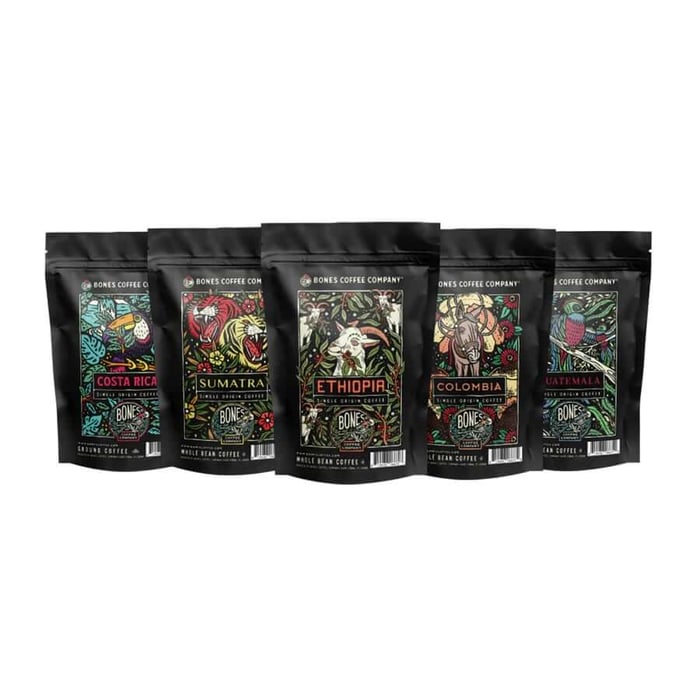 | World Tour Single-Origin Sample Pack delivers five meticulously roasted single-origin coffees from Sumatra, Costa Rica, Colombia, Ethiopia, and Guatemala. With 4oz per bag and up to ten cups of fresh coffee each, this sampler lets you experiment with different grind sizes across a world of flavors. |
What are the Best No-Grinder Methods by Coffee Brewing Style?
No coffee grinder? Use this table if you need to know how to grind coffee beans without a grinder, then dial in the details below.
Brewing Style | Ideal Grind | Best Alternative Method | Why It Works |
|---|---|---|---|
French press | Coarse | Mortar and pestle, rolling pin, hammer | Coarse grind suits long steep; fines are easy to skim |
Drip coffee maker | Medium | Blender, food processor | Consistent medium grind flows well through filters |
Pour-over | Medium (even) | Blender (careful pulse method) | Pour-over punishes uneven grounds; prioritize consistency |
Cold brew | Coarse | Rolling pin, mortar and pestle, food processor | Long steep time forgives minor unevenness |
French Press
A hand tool or hammer lands in the size an immersion brew needs. A few broken pieces do less damage here than in a drip or pour-over setup.
After steeping in water, skim any floating fines off the top. You can also extend brew time by a few minutes if the grind skews too coarse overall.
Drip Coffee Maker
A blender or food processor delivers the medium grind that drip makers depend on. Watch for excess powder in the coffee bean batch; it slows water flow through the filter and pushes bitterness into your cup of coffee.
A quick shake or sift to pull out oversized chunks before loading the filter keeps the extraction where it should be. The push of a button makes this a quick method.
Pour Over
Pour-over is demanding. Use a blender or food processor only when you can achieve a medium grind through the pulse method.
An even consistency matters more than reaching a specific fineness. If the coffee ground looks rough, try a slower water pour rate and a smaller brew volume to compensate.
The adjustments worth knowing before you start are covered in our guide on how to make pour-over coffee.
Cold Brew
Cold brew is the most forgiving brewing method for an alternative coffee grinder method. A heavy tool or food processor all work well here with a coarse grind size target.
Even if the particle size is mixed, the extended steep time compensates for minor inconsistency. This makes it the best starting way when you are new to preparing beans without a grinder.
What are the Common Mistakes When Using a Coffee Grinder Alternative?
Most disappointing cups of coffee from improvised grinding come down to the same handful of avoidable errors. Watch out for these:
- Grinding an oversized batch at once; work in modest amounts for better size distribution
- Running the blade without pulsing; heat builds and strips the flavor right out of the coffee grounds
- Using a flimsy bag that splits mid-crush, double-bag, or grab a thick bag before you start
- Chasing espresso-fine powder; improvised equipment cannot produce it, so set realistic expectations for the grind size you target
- Brewing with the wrong method for the produced batch; if you aimed for medium but landed too large, switch to French press or cold brew instead of forcing it through a filter
Freshly processing coffee beans is one of the single biggest upgrades you can make to a daily cup of coffee. Whole bean coffee preserves flavor longer than pre-ground alternatives.
If you find yourself without any tools, handle those full-on chaos situations with our guide on how to make coffee without a coffee maker.
Enjoy Flavorful Whole Coffee Beans at Home With Bones Coffee Company
Here is the main takeaway: even the cleverest improvised coffee grinder trick only goes as far as the quality of the coffee beans you start with. Whether you roll out large grounds with a heavy tool or pulse them through a blender, a bold, flavor-packed bean still drives the cup of coffee.
Bones Coffee whole coffee beans are roasted to order, so every bag lands at peak freshness. Explore our dark, medium, and light roasts today to discover bold flavors and a coffee experience made fresh for you.